
Your Custom Text Here
OSSO

I arrived mid-morning on Monday to Osso Carnicería, strapped down with my backpacks and sweating profusely. I had gone from the extreme cold of Denmark to extreme humidity of Peru, and I was starting to question if I’d packed correctly.
As I entered the shop, Renzo Girabaldi stood next to the counter chatting with some patrons. God, I was nervous. I mean, this was the guy I had wanted to work with for over three years. He and Dario Cecchini were my idols and the key reasons I became a butcher. And here he was, standing before me and offering the opportunity to apprentice with him for a few months.

A peak into one of the dry aging containers in the carnicería.
I didn't need to be anxious - Renzo was very welcoming. After he finished his conversation, we ventured upstairs to the roof where his office was located. After conversing a bit, Renzo laid out his suggested two-month plan.
- an intro week on the cutting table in the butcher shop
- two weeks in production, making hamburgers, chorizos, and other value-added products.
- a week ghosting Osso’s CFO Alejandro, analyzing logistics.
- two weeks of working at the adjoining Osso Restuarante
- two weeks working at Dondoh, a new restaurant collaboration of Renzo's.
When it came to accommodations, nothing had been planned prior to my arrival. Renzo and Alejandro went to work on a place for me to crash. In the meantime, I’d have to sleep at the butcher shop - not the first time that had happened.
Renzo had to jet - literally. He had less than 48 hours in Lima before he departed for a culinary gig in Moscow for 11 days. I’m thinking I’m at the right spot.
I went to the front counter, knife bundle in hand. The rest of the afternoon, I’m jumped in where I could help, mostly removing fat from pig skin. Renzo is a nose to tail man as well - he believes in saving every single little bit of fat. The hard fat is sent into hamburger production. The soft fat, the one that is usually thrown away or declared “too much work to remove” by some, is converted into Manteca de Cerdo, or Pork Lard. Renzo uses it all.

When dealing with dry aged meat, you have to trim off the outside surfaces - mostly dried meat and mold - in order to see the beauty hiding within.
My first week was spent in the shop, working around the large wooden cutting table. I was under the direction of César and Jose, Renzo's two main butchers. Every morning we started by setting the case - I took note of all the cuts, trying frantically to remember all the names in Spanish. My usual tasks were cleaning tenderloins, skirt steaks, and chorizo displays. Once the shop case was merchandised, we begin breaking down carcasses to fulfill the restaurants’ needs as well as wholesale orders.

José reminds me of some of those super quick butchers you see on YouTube: he can cut a mile a minute because he has done it a million times. He has been kind enough to share some his cutting "secretos" with me. José has taken a liking to my set of F. Dick knives. My large flat honing steel is now the preferred one at the table, and my boning knife stays busy, even when I'm on lunch break.

One of my morning tasks at Osso has been to restocking the sausage treys. Every shop displays their meat a little differently so I've tried to learn quickly - I still am having difficulties deciphering between the eight different sausages.
The guys at the cutting table realized I knew my cuts and that I knew a decent amount of Spanish. They wanted to learn English. By the end of my third day, my nickname had become “teacher.”
Or Jack "Sparrot." Not Sparrow.

Massive ribeyes headed to the restaurant.
I've enjoyed breaking out my Spanish again, but damn, I didn't remember it being this difficult! It doesn't help that my brain has a little Danish, French, or Italian rolling around in there.
I am fascinated by the setup at Osso, especially all the dry aging facilities. Cèsar demoed the famous sake-infused dry-aged ribeye on the DonDoh menu. After cleaning up the strip loin, he wrapped the entire hunk of meat in dried kelp leaves, then tied it up using medical netting. Cèsar carefully saturated the netting with just the right amount of sake before storing it in the dry-aging cooler.

César working the medical netting over the kelp-covered strip loin.
My second week was supposed to have been in production, making massive amounts hamburgers and chorizos. José and César pulled me up to the shop every morning - maybe they enjoyed my insanely sharp knives, or I was actually helping out.
I hope it was both!

Osso, just like the many European butchers I've met, deals with a bunch of quality pork meat. To supply super markets with artisanal chorizos, you need to have a lot of it!

This company has an incredible brand and top notch packaging!
Sidenotes:
Save the Gringo 1:
After a trio of nights in the butcher shop, Renzo and Alejandro fixed me up with my own pad - a small single room in La Molina, roughly a thirty-minute walk from the shop. I walked for the first week, but the humidity and the insanely cheap cab fare finally won me over. I'm very appreciative of the room. They didn't have to help out some gringo stranger from Texas, but they did.
Save Gringo 2:
It was about this same time I noticed an alarming number of bug bites on my arms and legs. For weeks, I had heard about "chinchas" or bed bugs down in South America - that was my first thought! I mentioned it to Renzo, and 15 minutes later, a company employee whisked me away to a public health clinic down the street to get treated (turns out it was an allergic reaction to a mosquito bite). Again, Gringo in trouble and Renzo saves the day - incredibly generous.

The Carnicería crew getting together for a group picture after my first week in La Molina.

I don't know what it is about staff meals, but I love them. Perhaps its the regathering of the troops to break bread together - the bond of a shared meal. At the Reata, I loved the tacos that the guys served up after the doors closed for the night. Fleishers staff meals in Red Hook were always spectacular thanks to Jason V. Here, a pan-fried potato stuffed with boiled eggs and minced chorizo meat. As with every staff meal here, there is rice and some sort of flavorful and fresh juice.
The Unofficial World Hot Dog Championship
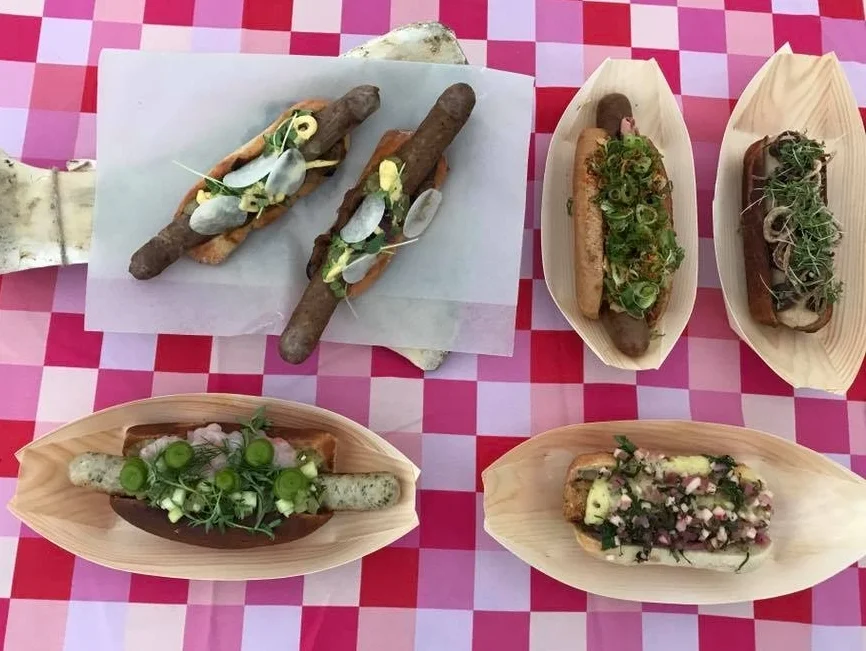
I'll be the first to tell you; I was playing out of my league.
The six-team contest had some big names:
Team Sweden: Brothers Ebbe Vollmer and Mats Thulin Vollmer from Restaurang Vollmer (2 Michelin Stars) in Malmø. The duo is known for straightforward, down-to-earth cooking using their exquisite home-grown produce.
Team South Africa: Korbus van der Merwe from Wolfgat in Paternoster. Korbus's mission is to cook sustainably while using super-local produce and ingredients.
Team Japan: Hideto Takeda, Mads Battlefield, and Henrik Levinsen from Ichimatsu and Restaurant Hjemme, respectively.
Team Denmark: Jonas Boelt, executive chef at Great Northern Food Hall in New York. There, he created a hot dog the NY Post claimed to be the top dog in New York.
Team Spain: Juan Antonio Vargas, head chef of Mugaritz - 9th best restaurant in the world and owner of three Michelin stars.
Oh, and a butcher from Texas...
In the months before the competition, the Folkets Madhus team and I tried to scheme up the ultimate butcher's hotdog - for awhile; there was talk of all the toppings being made from offal with a touch of fresh blood foam. I decided to compete with a more traditional dog rather than blow everyone away with a butcher's hot dog that would horrify some and cause others to turn vegan. The key word here is more traditional - I still wanted to play around with this dog. For a few weeks, I tested hot dog bun recipes, trying to make something unique. I'm not sure where the idea came from, but I decided to add some dehydrated prosciutto to my dough - a recipe that I will come back to and tweak one day. It definitely has some potential!
In place of a Texas-styled sausage, I opted for a traditional Danish grillepølse that highlights Nordic spices and seasonings. I thought this selection exemplified the spirit of the Butchers' Manifesto - the passage of the craft from one generation to the next. With the help of Mads Cortsen, I topped the dog with caramelized onions, pickled green tomatoes, thinly slice glass kale, a mayonnaise, and watercress.
The day of competition, Michael, Gustav, and I gathered at Torvehallerne. After we had assembled our station in our little hotdog trailer, we pulled out a bottle of Michael's famous Bacon Snaps and went to meet our competition.
Initially, the idea was to take the other teams off their "game" with a few swigs, but after hitting five trailers, we agreed our plan had somewhat backfired!
At last, the competition started: we had to serve 100 identical hotdogs to festival goers and an additional six for the judges. I came a little over-prepared, and we pushed out over 150 dogs. We quickly became the crowd favorite.
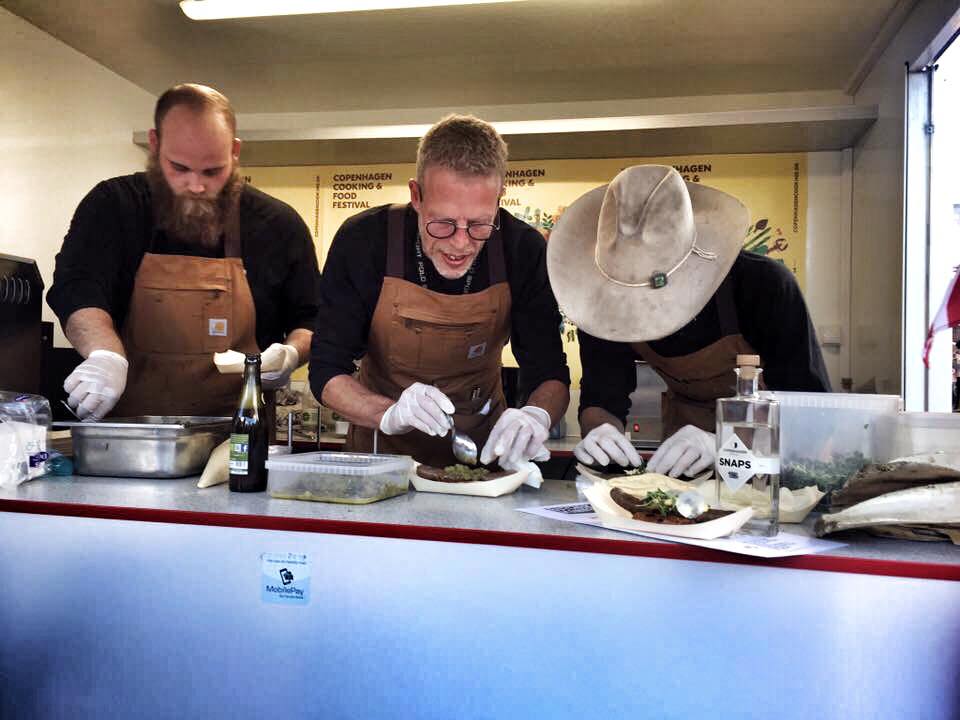
Gustav, Michael, and I busy at work in our small hot dog trailer. Here, Gustav took our wieners out of hot water, placing it in our fresh toasted buns. Michael came along with the caramelized onions and green tomatoes and I finished them off with the mayo, glass kale, and garnish.
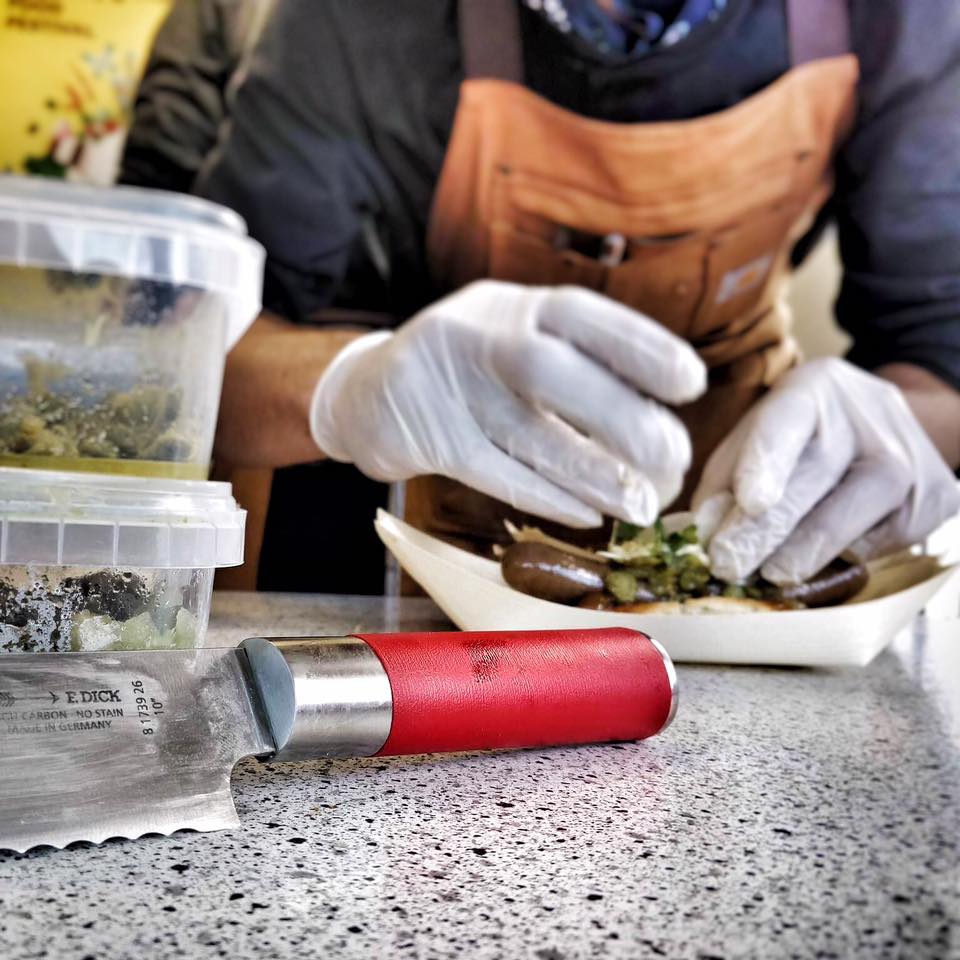
I relied heavily on all my F. Dick equipment for this contest - the bread knife was a work horse for those home-made buns!
Finally, the Master of Ceremonies called for all the chefs to come to the stage for the winning announcement. As I began to make my way out of the trailer, Michael he grabbed me by the shoulder.
"No, screw that! We don't move until they call for the butchers!"
He was right. This was our fight and that of the Butchers' Manifesto:
We are not chefs.
We are butchers.
In order to BRING BUTCHER BACK, we had to be recognized.
We held our ground. Shouts of "Vi Slagter!" ('We are butchers' in Danish) started to ring out from the crowd until finally, the "butchers" were called to the stage.
In the end, the top prize went to Team Japan, and rightfully so - their dog was killer. They loved Michael's Bacon Snaps so much that we gave them the rest of the bottle as an additional prize. You can see them celebrating with it on stage.

Team Japan taking the stage as the winning team of the Top Dog Charity contest - Congrats guys! Photo Credit: Copenhagen Food Festival.
,This was a great experience with lots of wonderful memories - we competed against some talented chefs. and were judged by some of the top chefs in the world. After the competition, I snuck over to the judge's table to get a picture with Ramus Kofoed, winner of the 2012 Bocuse d'Or - essentially, the Olympics of fine dining. Ramus also owns and operates Geranium, a three-star Michelin resturant in Copenhagen.
The experience was made possible by Michael Museth. It technically was a Butchers' Manifesto event, but he pushed for me to be on stage. For this, and all the other incredible opportunities he has given me, I am deeply appreciative.


SIDENOTE: A few weeks after the hotdog competition, Mads Cortsen competed in the Danish National Hotdog competition. His setup was hospital themed - he looked like a bloody surgeon while serving up his hotdogs and guess who got to make the buns?


License to Kill - a Way of Art
Jack Matusek makes food real again and it is not about all the fancy hipster stuff.
Magazine: Faces
November 2017

A lot can get lost in translation, but thanks to a good friend, this German article reads something like this:
This guy makes food real again as it is not about all the fancy hipster stuff (small portions, big money) but REAL meat, sausages, mince in a high-quality way. He is an ethical caveman who wants to show the art of proper slaughtering (with all the blood and bones). He loves animals and believes in treating them right which also includes the way in which they will be slaughtered. He has DVD’s to teach slaughtering which includes his “dance” and arty way of cutting a whole animal into the right pieces. His dream is to have a ranch (as he is from Texas) and set up a school for proper slaughtering. They call him the Calvin Klein Model with the charm of Crocodile Dundee.


Fleischer-Handwerk
FH FLEISCHER-HANDWERK
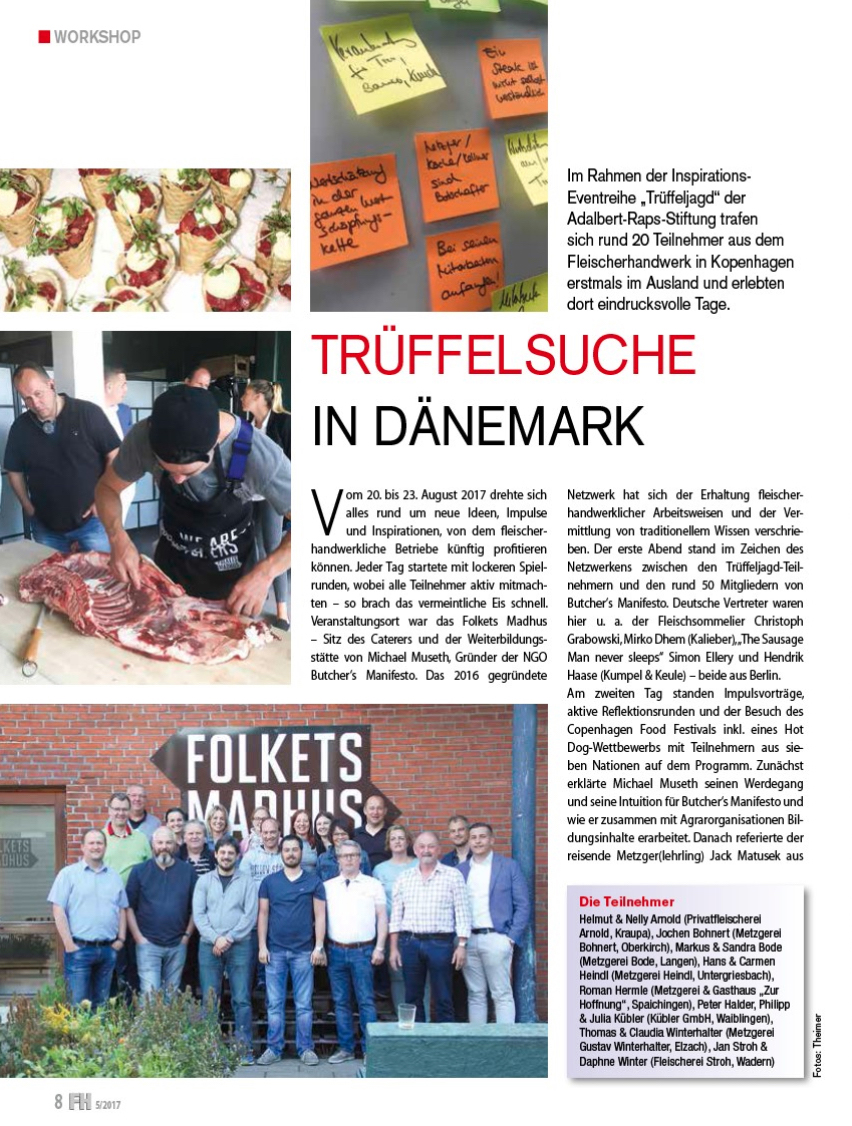
FH is a German magazine specializing in production and sale of artisan meat and sausage products. I am honored to be included in their May 2017 edition.

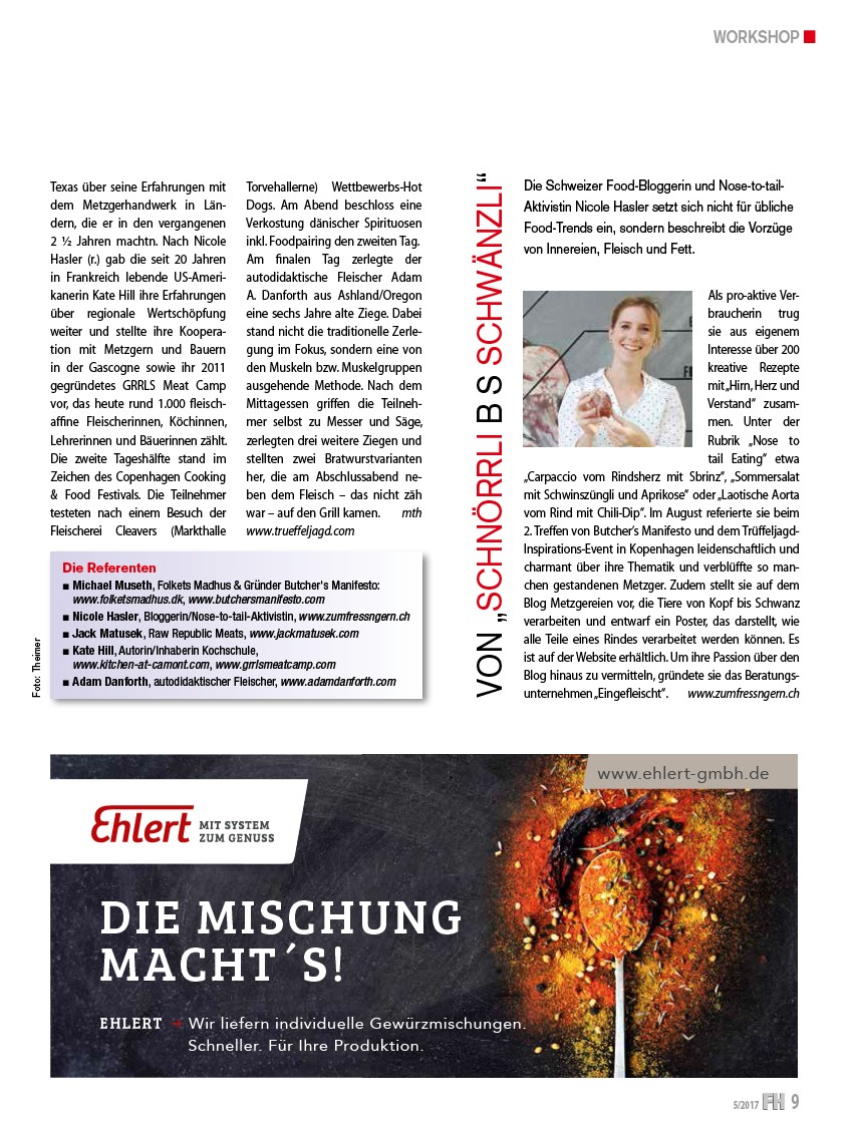
The Proof That Even Slaughterers Can Become Pop Stars Today
By Laura Ewert | WELT Iconist | Berlin | August 2017 | © WorldN24 GmbH. All rights reserved.
The modern butcher blogs and goes on educational journey

At least as beautiful as the meat products from his hands: The blogging butcher Jack Matusek
(Translated from Deutsch)
The butcher is often thick in movies, a bit angry. Sometimes bald. Chabrol rather thick-haired. He is wearing a white apron or white rubber boots and has reddened skin. He saws animals apart and leaves them on large hooks through the slaughterhouse. A place for psychotherapists. Battles are not nice.
Jack Matusek is beautiful. He is wearing a cowboy hat, long brown hair, sometimes green cowboy boots, sometimes a jeans shirt. A soft face. There are many photos of him, because he is a blogging butcher, in English, it sounds as nice as it looks: blogging butcher. He has large pieces of meat in his hand, he shows swine-ear terrines, or how to rouse a whole animal. On his "Raw Republic Meats" page, he writes about his travels, where he wants to learn everything about the craft. The 26-year-old is the proof that even slaughterers can become pop stars today - it helps of course if they look like this.
The slaughterer's new star potential is well explained by the rules of modern gourmets, who eat his bread only artisan and carrots grow blue or crooked. For him, food must be fresh, easily prepared with effort, best self-cultivated. And, of course, ethically correct. This is a tedious business, particularly in meat. One that moves the minds tremendously, in the face of animal protection, in which cow eyes look sadly from truck slits. In the case of conscious eaters, it is, therefore, a good idea to try to find out whether you can kill your food yourself (see the book "Eating Animals"), or at least making a few sausages yourself.
This explains why the butcher is so interested.
“The humble craft of the butcher is definitely coming - worldwide”, says Jack Matusek, who has found his model in Italy. ”I’ve seen videos of Dario Cecchini cutting meat, while he heard AC / DC . I was excited. Then I understood that it was more than cutting meat. It was art. ”
Traveling around the world all over the world
This craftsmanship charmed Matusek. He is a Texan, seventh generation.
“If I could wear my hat in the bed, I would do it, he says. ”
Texas is known for one of the most important economic sectors in the country, the cattle breeding. In 2011 the US produced more than one billion kilos of beef . "I grew up on a ranch. As a child, I enjoyed playing in the kitchen and refined my childish cooking skills, says Matussek. Combining cooking and cattle seemed to me a suitable idea."
At first, he studied history and business administration, where he also developed a business plan for a delicacy butchery. This idea grew more and more in him. "So I canceled the job offers after my graduation and decided to learn everything about the butcher's trade." That was 2015. Since then, he has been on an educational journey with regard to meat.
Jack Matusek first researched, wrote e-mails, and asked at various companies if he could learn from them. He enrolled at the best Fleischer school in the USA, Fleishers Craft Butchery in Brooklyn, New York. Because there was no free place for him, he worked in the next slaughterhouse to learn the basics.
At the same time, he began writing his blog. "I wanted to create a way to teach people about good meat with recipes and video tutorials." That's how you see how he cooks his steak. Directly in the fire. He calls it "Dirty Steak", and the video, in which he explains that you have to leave it four minutes per side in the fire to enjoy it "medium rare" is underlined with action music.
Finally, he moved to Europe. "If you want to learn to surf, go to California, if you want to learn something about sausage, go to France," he had read somewhere. So he sold his car, grabbed his backpack and went to France together with a cowboy hat and a good finish.
Learn from the best butcher
There he worked at the slaughterhouse, on a farm, in a restaurant, ate a lot and learned a lot about French sausages. He spent his 25th birthday at the "Le St. James", a Michelin-starred restaurant in Bordeaux.
Then he went on to Panzano in the Chianti, where he worked with his hero Dario Cecchini, the most famous butcher of Italy. Bill Buford, a New York journalist, was already working as a butcher's assistant. Cecchini sells the self-cut meat in his restaurant "Officina della Bistecca" (Italian for steak workshop).
Matusek then went to France again. In the Gascogne, he was introduced to the secret of national sausage specialties such as Pâté de Tête. He learned how to make the boneless ham Noix de Jambon from a pig's leg, and that any excess blood can cause the meat to rot during drying.
He also studied in Peru, Argentina, and Mexico. "Each country has its own style, which depends above all on local products. But also the climate and the weather influence the way of preparation and storage." A bit like the wine. The Germans, he says, are very exact at slaughter. They would hardly leave meat on the bone. The French cut rather elegantly.

Jack Matusek: "What did the animal eat, how did it live, how was it slaughtered - all that counts for the taste"
Like a cook, a butcher always has his knives, he recommends that of F. Dick. Matusek's favorite sausage specialty is the Italian Coppa of the Schweinenacken. And he loves Hanger steak, the tail of a long bison loin. He likes to work, the boy from the cattle country, but now with pig. "I just know the most about it now." And his favorite vegetable? This is the potato: "So versatile!" The best sausage is made from fresh ingredients, he says. Naturally. He is enthusiastic about Chorizo: "With different types of peppers, smoked, spicy or bittersweet." In addition, only meat from animals, which had grown well.
“What did it eat, how it lived, how it was slaughtered - all that counts ultimately for the taste.”
With extreme vegetarians , he had so far no problems. "Vegetarians love the welfare of the animals, just like me. Animals have to live a happy life, and they have a right to pain-free and decent slaughter. "
Battles, Blogging, and Travel
Matusek is currently working in Denmark, where he is working for a few months. At the end of August, he will come to Germany and look at some pig farms and abattoirs. For the future, he has nothing less than to produce the best sausage specialties in the world. For this, he has to found a company in which he can control everything - from the breeding of the animals through their rearing to their slaughter. "I hope I will return to my ranch in Texas and build an ethically correct slaughter house, with pig farming. And a school for the butchers."
In the meantime, he wants to travel further, to continue writing, to continue learning, to continue, as in Copenhagen at the annual "Butcher's Manifesto Summit". There meet Fleischer from all over the world, to formulate goals for the craft and to exchange ideas about what the world's foodie now calls charcuterie : Superstar meat products.
-
May 2022
- May 24, 2022 The Hand House May 24, 2022
-
May 2018
- May 16, 2018 Texas, Arizona, and Peru May 16, 2018
-
March 2018
- Mar 6, 2018 Bucket List Mar 6, 2018
-
February 2018
- Feb 19, 2018 OSSO Feb 19, 2018
- Feb 7, 2018 Pass the Cheese, Please. Feb 7, 2018
-
January 2018
- Jan 7, 2018 The Unofficial World Hot Dog Championship Jan 7, 2018
- Jan 2, 2018 Haven Festival Jan 2, 2018
-
November 2017
- Nov 20, 2017 We Are What We Eat Nov 20, 2017
- Nov 1, 2017 License to Kill - a Way of Art Nov 1, 2017
-
October 2017
- Oct 21, 2017 Fleischer-Handwerk Oct 21, 2017
- Oct 18, 2017 Mad Food with Mads Cortsen Oct 18, 2017
-
August 2017
- Aug 14, 2017 Roskilde Festival Aug 14, 2017
- Aug 2, 2017 The Proof That Even Slaughterers Can Become Pop Stars Today Aug 2, 2017
-
June 2017
- Jun 6, 2017 Where to Find Pig Ear Terrines, Spicy Nduja and Other Adventurous Charcuterie in Dallas Jun 6, 2017
- Jun 5, 2017 Cochon555 Houston Jun 5, 2017
-
May 2017
- May 23, 2017 Charcuterie Masters 2017 May 23, 2017
- May 18, 2017 Dirty Steaks May 18, 2017
- May 16, 2017 Dîner en Blanc May 16, 2017
- May 10, 2017 Steensgaard May 10, 2017
-
April 2017
- Apr 4, 2017 Gascon Fricandeaux Apr 4, 2017
- Apr 3, 2017 American Kid Apr 3, 2017
-
March 2017
- Mar 27, 2017 Folkets Madhus Mar 27, 2017
- Mar 23, 2017 Another Open Door Mar 23, 2017
- Mar 13, 2017 Yoakum Man Learns Old World Butchery Mar 13, 2017
-
February 2017
- Feb 20, 2017 Great Day Houston Feb 20, 2017
-
December 2016
- Dec 4, 2016 Creating the Manifesto Dec 4, 2016
- Dec 4, 2016 Meating Fellow Revolutionaries Dec 4, 2016
- Dec 4, 2016 The Butchers' Manifesto Origins Dec 4, 2016
-
November 2016
- Nov 10, 2016 The Sausage Man Never Sleeps Nov 10, 2016
-
October 2016
- Oct 19, 2016 Road Trippin' Across Europe Oct 19, 2016
- Oct 2, 2016 Vide Greniers: the French Garage Sale Oct 2, 2016
-
September 2016
- Sep 20, 2016 Je N'ai Plus Faim Sep 20, 2016
- Sep 13, 2016 Noix de Jambon Sep 13, 2016
-
August 2016
- Aug 28, 2016 The Chapolard Family of Gascony Aug 28, 2016
- Aug 7, 2016 The Cowboy, the Expat, and the Englishman Aug 7, 2016
-
July 2016
- Jul 31, 2016 France - Right Where I Need to Be Jul 31, 2016
- Jul 25, 2016 Fambam in Italy Jul 25, 2016
- Jul 11, 2016 Red is His Signature Color Jul 11, 2016
- Jul 4, 2016 Doin' It Like Dario Jul 4, 2016
-
June 2016
- Jun 19, 2016 Trouble in Paradise Jun 19, 2016
- Jun 8, 2016 Tex-Mex Night in Italy Jun 8, 2016
-
May 2016
- May 29, 2016 The King of Beef Does Porchetta May 29, 2016
- May 12, 2016 It's a Long Way to the Top May 12, 2016
- May 10, 2016 Viva La Cicca! May 10, 2016
- May 1, 2016 It’s Crazy What Can Happen in a Year May 1, 2016
-
April 2016
- Apr 26, 2016 The Kitchen at Camont and the Art of Charcuterie Apr 26, 2016
- Apr 12, 2016 Keeping It Under My Hat Apr 12, 2016
- Apr 3, 2016 Let Them Eat Cake Apr 3, 2016
-
March 2016
- Mar 22, 2016 Kolaches versus Klobasniky Mar 22, 2016
- Mar 3, 2016 The Queue for some sweet 'Cue Mar 3, 2016
-
February 2016
- Feb 21, 2016 POS Meat Grinders Feb 21, 2016
-
January 2016
- Jan 21, 2016 Earth Oven Tragedy Jan 21, 2016
- Jan 17, 2016 This ‘ol Gal is Smoking Hot Jan 17, 2016
- Jan 12, 2016 The Gringo and la Reina Tamal Jan 12, 2016
- Jan 7, 2016 Packin' Pork Jan 7, 2016
-
December 2015
- Dec 23, 2015 Empire State of Mind Dec 23, 2015
- Dec 10, 2015 Meat Monger Dec 10, 2015
-
November 2015
- Nov 23, 2015 Jerky Game Strong Nov 23, 2015
- Nov 11, 2015 Breaking Lamb Nov 11, 2015
- Nov 1, 2015 Breaking Pork Nov 1, 2015
-
October 2015
- Oct 26, 2015 Like Cocaine in the '80's Oct 26, 2015
- Oct 21, 2015 Fleishers Craft Butchery: Day 1 Oct 21, 2015
- Oct 11, 2015 Year of the Cow Oct 11, 2015
- Oct 4, 2015 13th Step to Manhattan Oct 4, 2015
-
September 2015
- Sep 27, 2015 Brooklyn Cowboy Sep 27, 2015
- Sep 27, 2015 Vaya con Dios Sep 27, 2015
- Sep 14, 2015 Mystic Goat Roper Sep 14, 2015
- Sep 10, 2015 Green-hand Gringo Sep 10, 2015
- Sep 10, 2015 Shell Station Burgers Sep 10, 2015
- Sep 10, 2015 Butter 'Em Up Sep 10, 2015
- Sep 10, 2015 Why The Hell Not? Sep 10, 2015