
Your Custom Text Here
The Unofficial World Hot Dog Championship
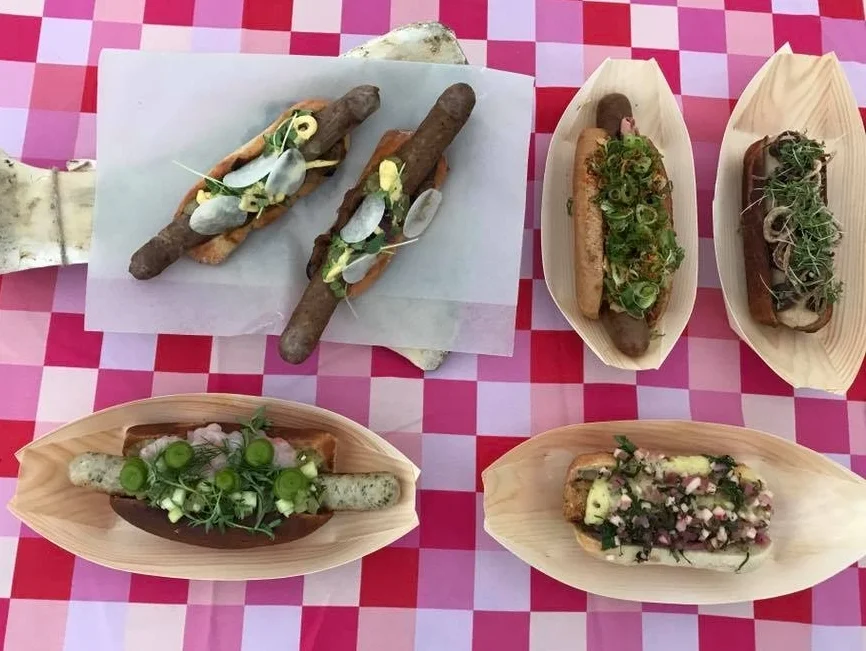
I'll be the first to tell you; I was playing out of my league.
The six-team contest had some big names:
Team Sweden: Brothers Ebbe Vollmer and Mats Thulin Vollmer from Restaurang Vollmer (2 Michelin Stars) in Malmø. The duo is known for straightforward, down-to-earth cooking using their exquisite home-grown produce.
Team South Africa: Korbus van der Merwe from Wolfgat in Paternoster. Korbus's mission is to cook sustainably while using super-local produce and ingredients.
Team Japan: Hideto Takeda, Mads Battlefield, and Henrik Levinsen from Ichimatsu and Restaurant Hjemme, respectively.
Team Denmark: Jonas Boelt, executive chef at Great Northern Food Hall in New York. There, he created a hot dog the NY Post claimed to be the top dog in New York.
Team Spain: Juan Antonio Vargas, head chef of Mugaritz - 9th best restaurant in the world and owner of three Michelin stars.
Oh, and a butcher from Texas...
In the months before the competition, the Folkets Madhus team and I tried to scheme up the ultimate butcher's hotdog - for awhile; there was talk of all the toppings being made from offal with a touch of fresh blood foam. I decided to compete with a more traditional dog rather than blow everyone away with a butcher's hot dog that would horrify some and cause others to turn vegan. The key word here is more traditional - I still wanted to play around with this dog. For a few weeks, I tested hot dog bun recipes, trying to make something unique. I'm not sure where the idea came from, but I decided to add some dehydrated prosciutto to my dough - a recipe that I will come back to and tweak one day. It definitely has some potential!
In place of a Texas-styled sausage, I opted for a traditional Danish grillepølse that highlights Nordic spices and seasonings. I thought this selection exemplified the spirit of the Butchers' Manifesto - the passage of the craft from one generation to the next. With the help of Mads Cortsen, I topped the dog with caramelized onions, pickled green tomatoes, thinly slice glass kale, a mayonnaise, and watercress.
The day of competition, Michael, Gustav, and I gathered at Torvehallerne. After we had assembled our station in our little hotdog trailer, we pulled out a bottle of Michael's famous Bacon Snaps and went to meet our competition.
Initially, the idea was to take the other teams off their "game" with a few swigs, but after hitting five trailers, we agreed our plan had somewhat backfired!
At last, the competition started: we had to serve 100 identical hotdogs to festival goers and an additional six for the judges. I came a little over-prepared, and we pushed out over 150 dogs. We quickly became the crowd favorite.
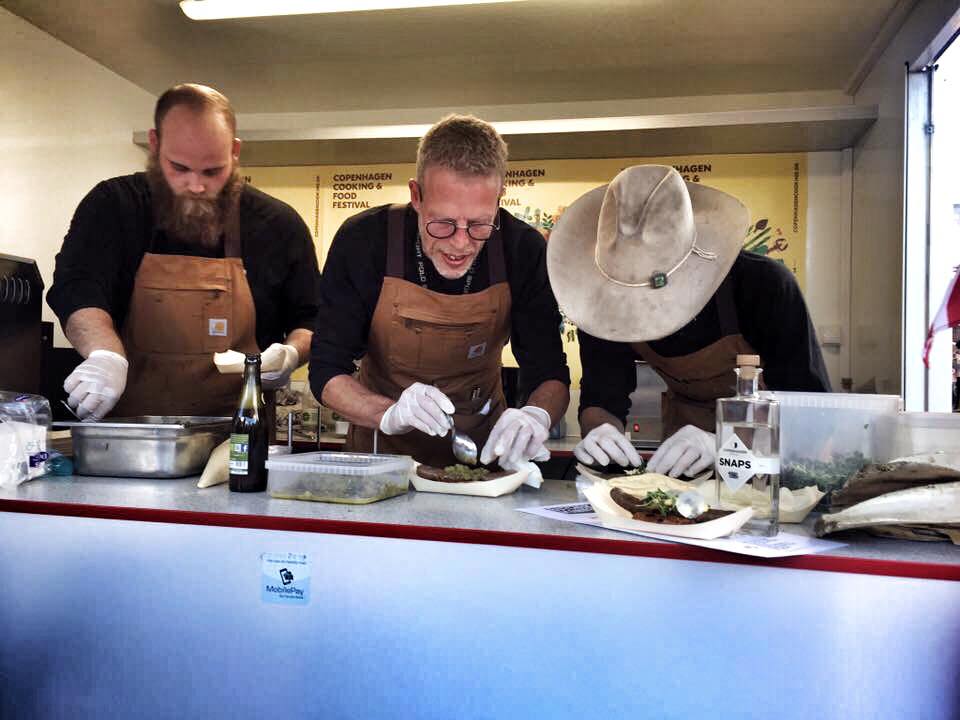
Gustav, Michael, and I busy at work in our small hot dog trailer. Here, Gustav took our wieners out of hot water, placing it in our fresh toasted buns. Michael came along with the caramelized onions and green tomatoes and I finished them off with the mayo, glass kale, and garnish.
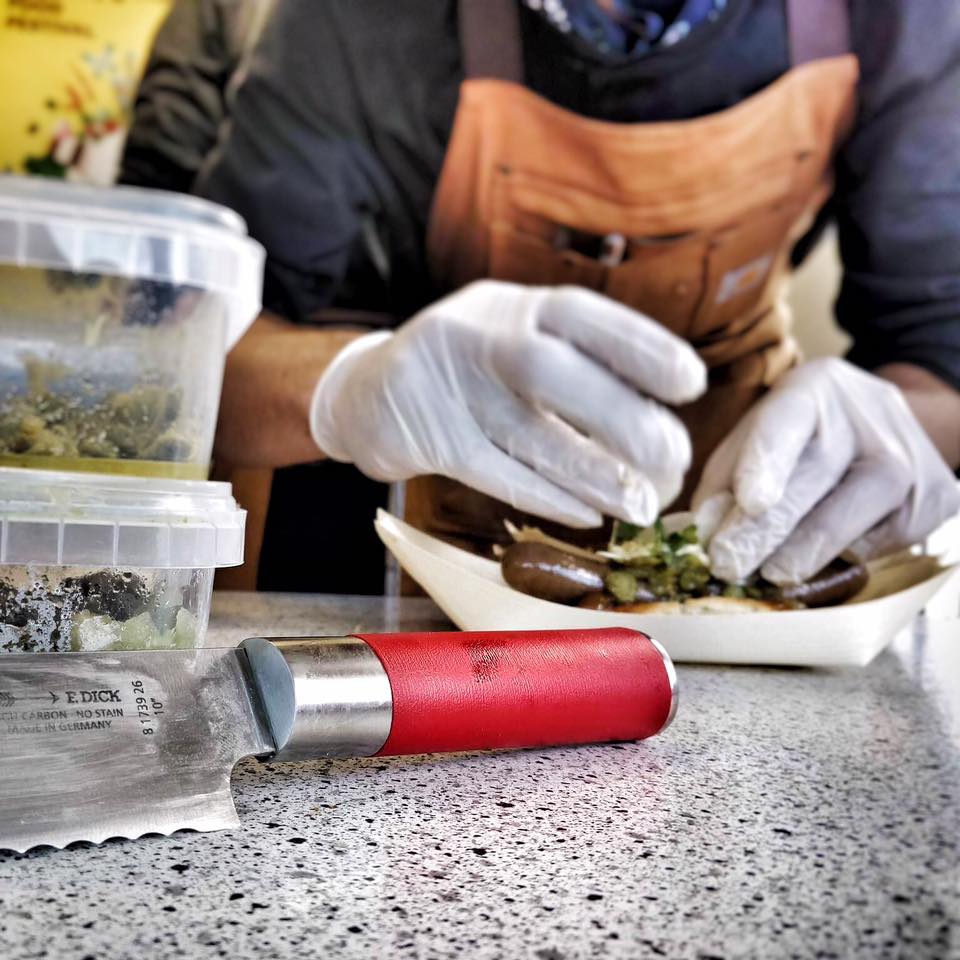
I relied heavily on all my F. Dick equipment for this contest - the bread knife was a work horse for those home-made buns!
Finally, the Master of Ceremonies called for all the chefs to come to the stage for the winning announcement. As I began to make my way out of the trailer, Michael he grabbed me by the shoulder.
"No, screw that! We don't move until they call for the butchers!"
He was right. This was our fight and that of the Butchers' Manifesto:
We are not chefs.
We are butchers.
In order to BRING BUTCHER BACK, we had to be recognized.
We held our ground. Shouts of "Vi Slagter!" ('We are butchers' in Danish) started to ring out from the crowd until finally, the "butchers" were called to the stage.
In the end, the top prize went to Team Japan, and rightfully so - their dog was killer. They loved Michael's Bacon Snaps so much that we gave them the rest of the bottle as an additional prize. You can see them celebrating with it on stage.

Team Japan taking the stage as the winning team of the Top Dog Charity contest - Congrats guys! Photo Credit: Copenhagen Food Festival.
,This was a great experience with lots of wonderful memories - we competed against some talented chefs. and were judged by some of the top chefs in the world. After the competition, I snuck over to the judge's table to get a picture with Ramus Kofoed, winner of the 2012 Bocuse d'Or - essentially, the Olympics of fine dining. Ramus also owns and operates Geranium, a three-star Michelin resturant in Copenhagen.
The experience was made possible by Michael Museth. It technically was a Butchers' Manifesto event, but he pushed for me to be on stage. For this, and all the other incredible opportunities he has given me, I am deeply appreciative.


SIDENOTE: A few weeks after the hotdog competition, Mads Cortsen competed in the Danish National Hotdog competition. His setup was hospital themed - he looked like a bloody surgeon while serving up his hotdogs and guess who got to make the buns?

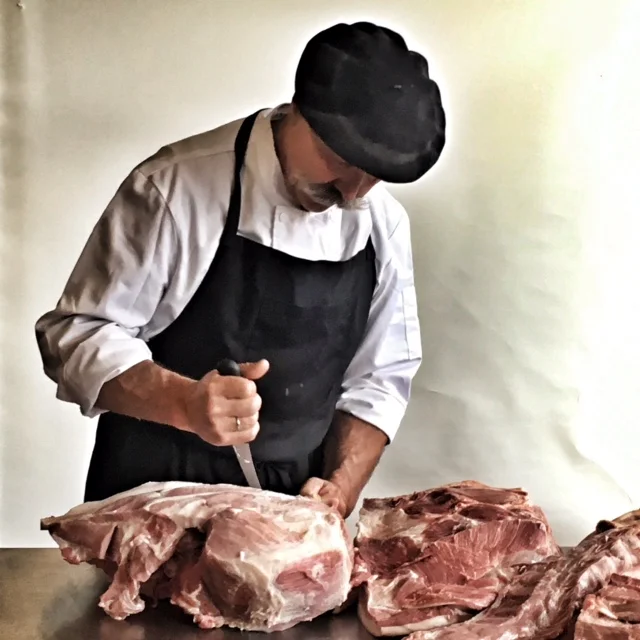
Creating the Manifesto
This is the last of a 3-part series. You can catch up by reading Road Trippin' Across Europe (Prolog), Origins - part 1, and Meating Fellow Revolutionaries, part 2.
We were up early the next morning and ready to begin the formulation of the Manifesto. Michael had outlined five key points he wanted to touch on in our mission statement:
- Tradition
- Quality
- Education
- Craft
- People
For each of these subjects, Michael had assigned a speaker who would lead the discussion for 15-20 minutes after which we would begin a group discussion. All the speakers were experts in their respected fields.

TRADITIONS:
The “traditions” segment was lead Henning Wiesinger, owner of Steensgaard Farms, a Danish nose-to-tail farm, slaughter facility, and butcher shop.
They do it all under one roof, from “seed to sausage”.
He discussed how the connection between the farmer and butcher has become lost, but fortunately, Steensgaard has been instrumental in preserving this traditional method of butchery. The unique aspect of Steensgaard is their method and ideology of harvesting. Their animals aren't transported to a distant slaughterhouse - they are harvested right on the farm using a state of the art harvest facility. It is the farmers who know the animals and lead them to the slaughterhouse where they go in a special enclosure until they are slaughtered. This ensures the lowest possible stress levels to the animals. Once slaughtered, the carcasses are immediately hung up and broken down while still warm, ensuring a quality product. It also provides close cooperation between the farmer and butcher by creating opportunities for them to work together on meat quality and product development.
After Henning finished, we came together as a whole and tried to outline a statement on traditions.
We honor the valuable traditions of butchery.
It might seem very simple, but you have no idea how much discussion and thought went into that sentence.

QUALITY:
Adam Danforth, a James Beard award-winning author and butcher from Oregon then spoke on the topic of quality. Adam is an advocate for consuming older animals – these animals have more time to develop complex flavor in their meat. He also emphasizes flavor over texture, while the rest of the world buys the exact opposite. This discussion then led into another concerning the long-term sustainability of meat. The earth cannot support 7 billion people who eat meat every day. Adam's solution: eat less, but better meat.
Again, we converged for group discussion. The main point in this session was ensuring that superior quality was maintained through the whole process, from seed to sausage.
We insist on transparent and honest meat.
EDUCATION:
Michael lacked a speaker for his point on education. Moved by my non-traditional path to butchery, he asked me if I would be willing to speak on the subject the night before.
Me?
I was the youngest butcher there and had little experience compared to the old guys who were born with blood stained knives in their hands.
But I wasn’t going to turn an opportunity like this down.
After a quick lunch break consisting of some incredible beef cheek tacos, it was my turn.
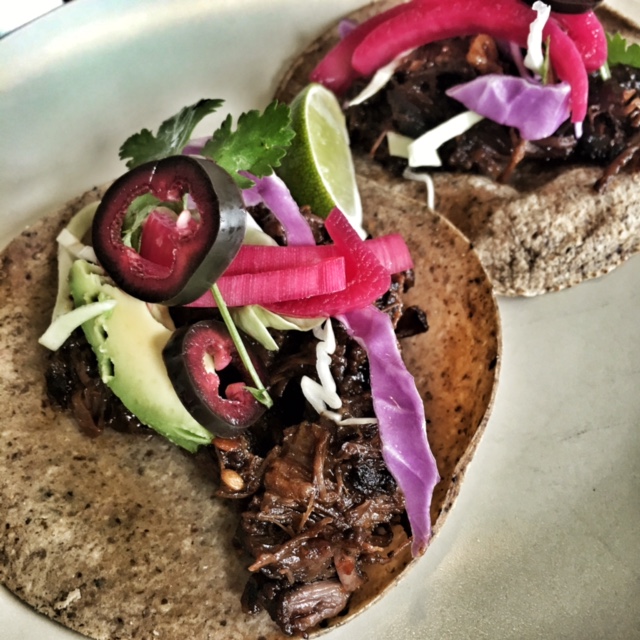
I’ve done a lot of public speaking in my life. I even spent a lot of time acting as a kid and I’ve got two state titles to prove it. But, this was different. This was my career.
I’m not going to lie, I was nervous.
After a quick prayer, I took my place at the head of the room and began to tell my story: The revelation in my Entrepreneurship class at TCU, the slaughterhouse down in South Texas, selling my car to pay for a three-month apprenticeship at Fleishers in NYC, as well as my time in France and Italy.
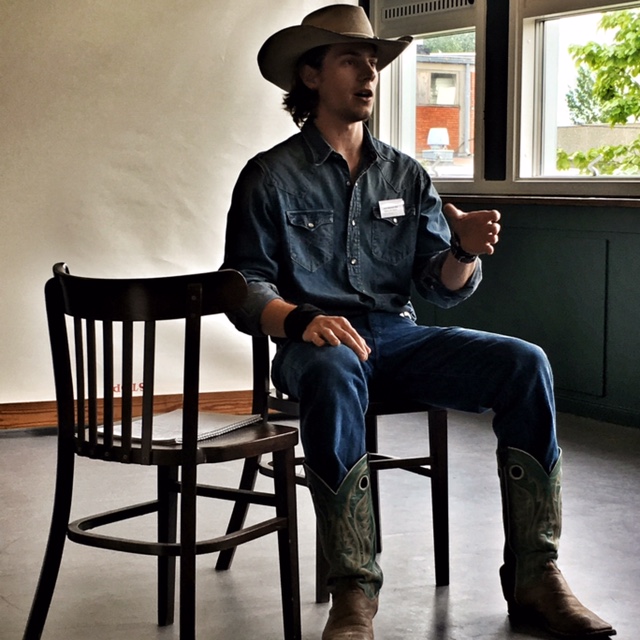
The discussion that followed centered around setting up a cost-free international apprenticeship program among the butchers involved in the manifesto, with me as the example and guinea pig.
We promote the exchange of knowledge and expertise.
CRAFT:
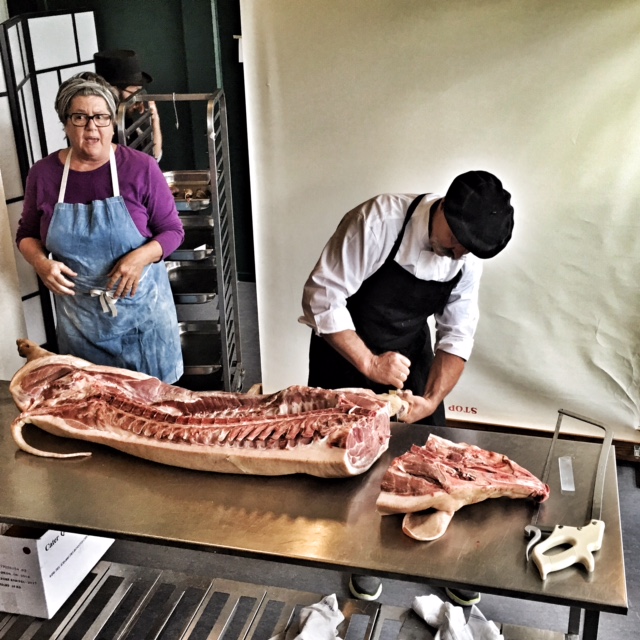
Dominique Chapolard and Kate Hill handled “Craft.” While Kate talked about the Chapolard system and butchery in France, Dominique went to work on a half carcass, demonstrating his skills. Many butchers hadn’t seen a carcass broken-down with this method before.
We represent a craft that is the joyful expression of tradition and innovation.
PEOPLE:
Olga Graf and Akina Kai, two design thinkers from Berlin, were charged with helping these butchers think “outside the box.” They led a discussion revolving around the interactions between butchers and consumers.
We lead the conversation about responsible consumption of meat.

After Kate and Adam had tweaked the wording a bit, the Manifesto was ready to sign.
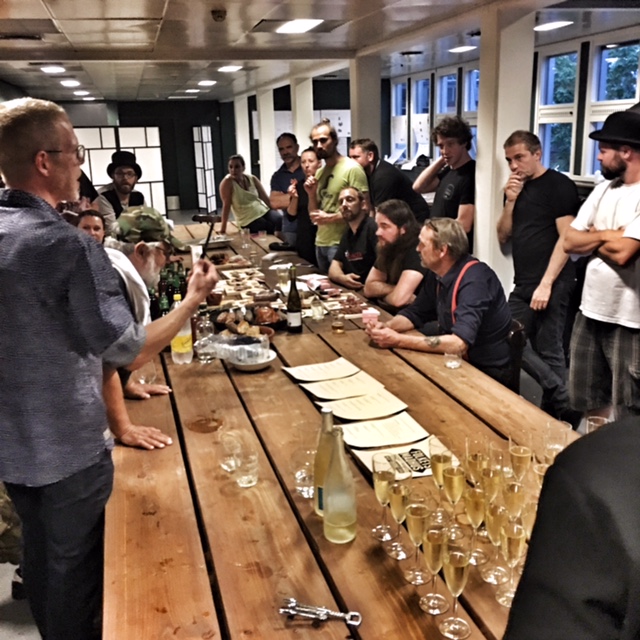
One by one, we were called to sign the document. A roar of applause filled the hall as Michael, the last to sign, finished his signature.

This was the first step in the organized meat revolution. As a craft, we have grown tired of the unethical practices and inferior products from large industrial meat companies. We have set in place guidelines by which we can organize behind.
Yes, it probably didn’t seem like much to you as a reader; however there was a lot of thought and conversation behind those five lines.
I’m sure they will be modified and changed at the next summit, but until then, it’s a start.
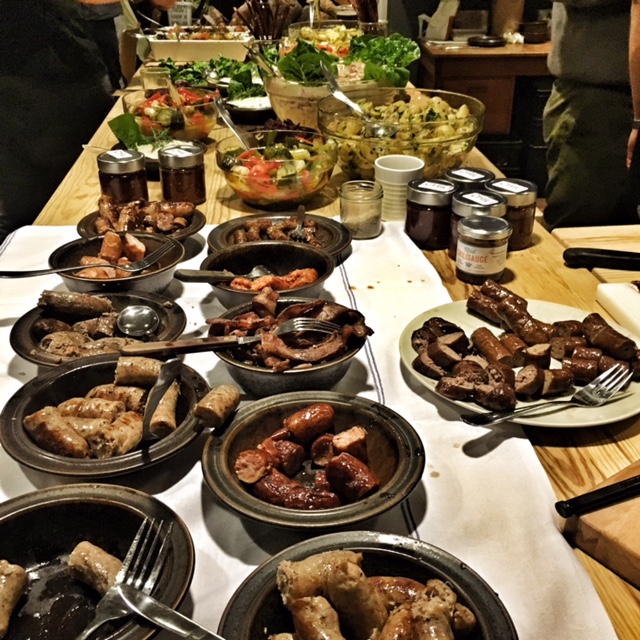
After a long day of discussion, carts of beer were rolled in. Everyone started breaking out his or her products for sampling.
-
May 2022
- May 24, 2022 The Hand House May 24, 2022
-
May 2018
- May 16, 2018 Texas, Arizona, and Peru May 16, 2018
-
March 2018
- Mar 6, 2018 Bucket List Mar 6, 2018
-
February 2018
- Feb 19, 2018 OSSO Feb 19, 2018
- Feb 7, 2018 Pass the Cheese, Please. Feb 7, 2018
-
January 2018
- Jan 7, 2018 The Unofficial World Hot Dog Championship Jan 7, 2018
- Jan 2, 2018 Haven Festival Jan 2, 2018
-
November 2017
- Nov 20, 2017 We Are What We Eat Nov 20, 2017
- Nov 1, 2017 License to Kill - a Way of Art Nov 1, 2017
-
October 2017
- Oct 21, 2017 Fleischer-Handwerk Oct 21, 2017
- Oct 18, 2017 Mad Food with Mads Cortsen Oct 18, 2017
-
August 2017
- Aug 14, 2017 Roskilde Festival Aug 14, 2017
- Aug 2, 2017 The Proof That Even Slaughterers Can Become Pop Stars Today Aug 2, 2017
-
June 2017
- Jun 6, 2017 Where to Find Pig Ear Terrines, Spicy Nduja and Other Adventurous Charcuterie in Dallas Jun 6, 2017
- Jun 5, 2017 Cochon555 Houston Jun 5, 2017
-
May 2017
- May 23, 2017 Charcuterie Masters 2017 May 23, 2017
- May 18, 2017 Dirty Steaks May 18, 2017
- May 16, 2017 Dîner en Blanc May 16, 2017
- May 10, 2017 Steensgaard May 10, 2017
-
April 2017
- Apr 4, 2017 Gascon Fricandeaux Apr 4, 2017
- Apr 3, 2017 American Kid Apr 3, 2017
-
March 2017
- Mar 27, 2017 Folkets Madhus Mar 27, 2017
- Mar 23, 2017 Another Open Door Mar 23, 2017
- Mar 13, 2017 Yoakum Man Learns Old World Butchery Mar 13, 2017
-
February 2017
- Feb 20, 2017 Great Day Houston Feb 20, 2017
-
December 2016
- Dec 4, 2016 Creating the Manifesto Dec 4, 2016
- Dec 4, 2016 Meating Fellow Revolutionaries Dec 4, 2016
- Dec 4, 2016 The Butchers' Manifesto Origins Dec 4, 2016
-
November 2016
- Nov 10, 2016 The Sausage Man Never Sleeps Nov 10, 2016
-
October 2016
- Oct 19, 2016 Road Trippin' Across Europe Oct 19, 2016
- Oct 2, 2016 Vide Greniers: the French Garage Sale Oct 2, 2016
-
September 2016
- Sep 20, 2016 Je N'ai Plus Faim Sep 20, 2016
- Sep 13, 2016 Noix de Jambon Sep 13, 2016
-
August 2016
- Aug 28, 2016 The Chapolard Family of Gascony Aug 28, 2016
- Aug 7, 2016 The Cowboy, the Expat, and the Englishman Aug 7, 2016
-
July 2016
- Jul 31, 2016 France - Right Where I Need to Be Jul 31, 2016
- Jul 25, 2016 Fambam in Italy Jul 25, 2016
- Jul 11, 2016 Red is His Signature Color Jul 11, 2016
- Jul 4, 2016 Doin' It Like Dario Jul 4, 2016
-
June 2016
- Jun 19, 2016 Trouble in Paradise Jun 19, 2016
- Jun 8, 2016 Tex-Mex Night in Italy Jun 8, 2016
-
May 2016
- May 29, 2016 The King of Beef Does Porchetta May 29, 2016
- May 12, 2016 It's a Long Way to the Top May 12, 2016
- May 10, 2016 Viva La Cicca! May 10, 2016
- May 1, 2016 It’s Crazy What Can Happen in a Year May 1, 2016
-
April 2016
- Apr 26, 2016 The Kitchen at Camont and the Art of Charcuterie Apr 26, 2016
- Apr 12, 2016 Keeping It Under My Hat Apr 12, 2016
- Apr 3, 2016 Let Them Eat Cake Apr 3, 2016
-
March 2016
- Mar 22, 2016 Kolaches versus Klobasniky Mar 22, 2016
- Mar 3, 2016 The Queue for some sweet 'Cue Mar 3, 2016
-
February 2016
- Feb 21, 2016 POS Meat Grinders Feb 21, 2016
-
January 2016
- Jan 21, 2016 Earth Oven Tragedy Jan 21, 2016
- Jan 17, 2016 This ‘ol Gal is Smoking Hot Jan 17, 2016
- Jan 12, 2016 The Gringo and la Reina Tamal Jan 12, 2016
- Jan 7, 2016 Packin' Pork Jan 7, 2016
-
December 2015
- Dec 23, 2015 Empire State of Mind Dec 23, 2015
- Dec 10, 2015 Meat Monger Dec 10, 2015
-
November 2015
- Nov 23, 2015 Jerky Game Strong Nov 23, 2015
- Nov 11, 2015 Breaking Lamb Nov 11, 2015
- Nov 1, 2015 Breaking Pork Nov 1, 2015
-
October 2015
- Oct 26, 2015 Like Cocaine in the '80's Oct 26, 2015
- Oct 21, 2015 Fleishers Craft Butchery: Day 1 Oct 21, 2015
- Oct 11, 2015 Year of the Cow Oct 11, 2015
- Oct 4, 2015 13th Step to Manhattan Oct 4, 2015
-
September 2015
- Sep 27, 2015 Brooklyn Cowboy Sep 27, 2015
- Sep 27, 2015 Vaya con Dios Sep 27, 2015
- Sep 14, 2015 Mystic Goat Roper Sep 14, 2015
- Sep 10, 2015 Green-hand Gringo Sep 10, 2015
- Sep 10, 2015 Shell Station Burgers Sep 10, 2015
- Sep 10, 2015 Butter 'Em Up Sep 10, 2015
- Sep 10, 2015 Why The Hell Not? Sep 10, 2015